The vast majority of Czechs wash their laundry at home, most commonly running one to three washing cycles per week. This is according to a survey conducted by Neubert Marketing for the Czech Association for Textile Care (APaČ). Approximately three in ten Czechs have used professional laundry or dry-cleaning services. Among businesses and institutions where textile care is an integral part of daily operations, as many as 81% work with an external service provider. Laundry and dry-cleaning operators themselves are optimistic about current market developments, with four in ten planning to increase their capacity in the coming years. However, they continue to face challenges such as high energy prices and labour shortages.
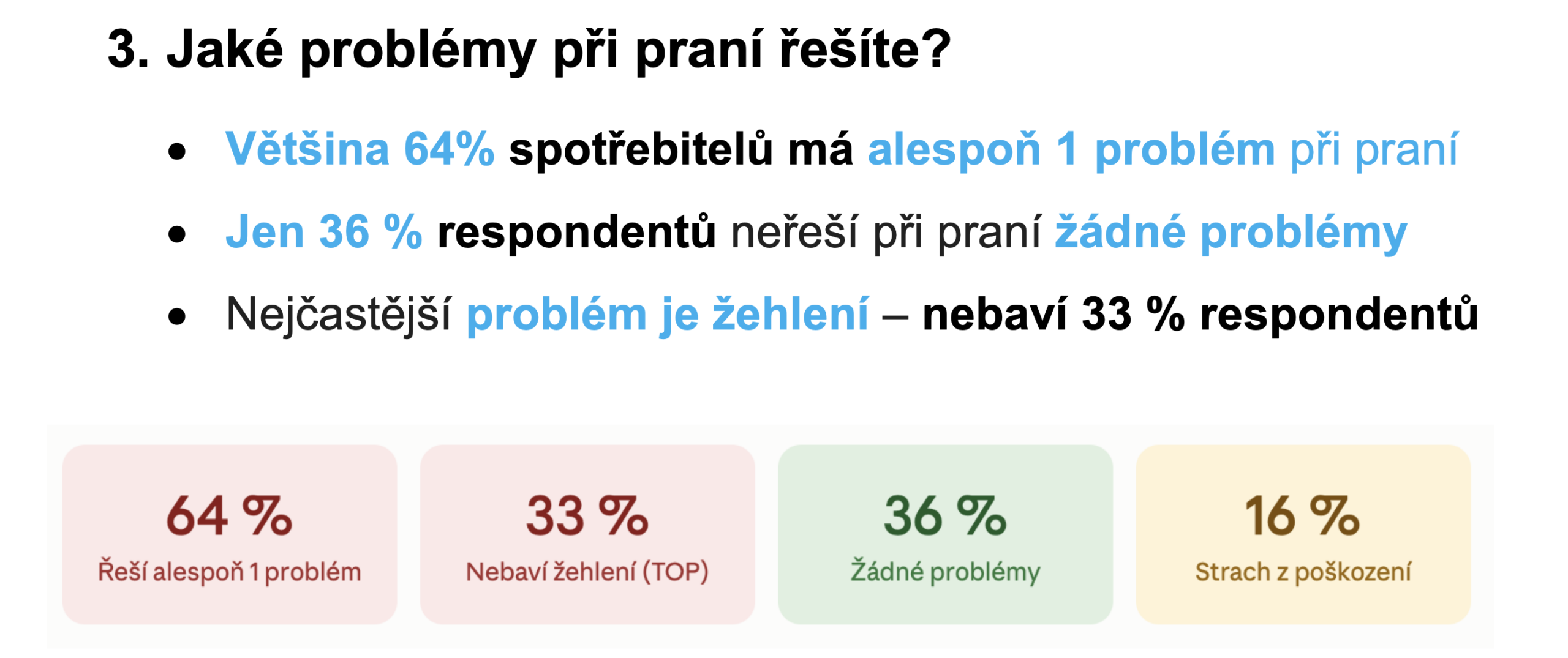
More than 98% of Czech households wash their laundry at home using their own washing machines. They typically do one to three loads per week, which is in line with the European average. These findings come from a new survey conducted by Neubert Marketing for the Czech Association for Textile Care (APaČ). The analysis also revealed that 64% of respondents experience at least one specific difficulty when doing their laundry.
“Ironing was the most frequently mentioned issue, with one-third of respondents finding it particularly bothersome. Other concerns included the risk of damaging clothes, limited washing machine capacity, lack of time and difficulties with drying. Women were more likely to mention ironing and concerns about damaging garments, while men more frequently expressed a general dislike of doing laundry,” explains Jana Puškáčová, President of APaČ.
31% of Czechs Have Used Professional Laundry or Dry-Cleaning Services
Approximately one-third of respondents have used professional laundry or dry-cleaning services at least once, while 60% have never tried them. People aged 36 to 50 have the most experience with these services, and their use also increases significantly with the volume of laundry. Among households running seven or more washing cycles per week, 56% of respondents have used professional laundry services.
“The main barrier is not a lack of trust in professional services, but rather the established habit of washing clothes at home, which 55% of respondents cited as their primary reason,” adds Puškáčová.
A further one-third are discouraged by the perceived high cost of professional laundry services, while one in five are concerned about the time involved, including waiting times and transporting laundry to and from the service provider.
Czechs Would Welcome Smart Laundry Lockers
Although only a relatively small proportion of Czech households currently use professional laundry services, demand could increase in the future. As many as 83% of respondents can imagine using some form of professional laundry service in the coming years.
A total of 45% would be willing to spend up to CZK 500 per month on these services, while a further 25% would be prepared to spend up to CZK 1,000. Women, and somewhat surprisingly, higher-income households, tend to be less willing to spend money on professional laundry services.
“When it comes to consumers’ expectations for the future of laundry services, more than half of respondents would welcome smart laundry lockers, where they could drop off their clothes at any time and collect them once they have been cleaned. This is by no means a futuristic concept, as similar lockers are already operating in a number of locations across the Czech Republic,” says Martina Prošková, Managing Director of Prádelna a čistírna Jihlava and First Vice-President of APaČ.
Professional Laundry Services Are Indispensable for Most Businesses in Relevant Sectors
The survey also focused on businesses and institutions operating in sectors where professional textile care plays an important role in everyday operations. These include hotels and restaurants, healthcare facilities, wellness and sports centres, food production and industrial companies.
“Among the companies surveyed, 81% use external laundry or dry-cleaning services, while only 19% handle all their laundry needs in-house. The use of external services increases with company size, reaching 90% among businesses with more than 200 employees,” explains Jan Chrištof, Managing Director of Chrištof Laundry and Second Vice-President of APaČ.
The most frequently requested services are washing and drying, used by 86% of clients, followed by ironing and flatwork ironing, requested by 76%.
The largest proportion of businesses (37%) process between 50 and 150 kilograms of laundry per week. A further 26% handle up to 50 kilograms weekly, while one in five process between 150 and 500 kilograms. Approximately 17% of companies process more than 500 kilograms per week, with one in ten exceeding one tonne of laundry weekly.
Customer satisfaction is also high, with 88% of respondents expressing satisfaction with the services provided, while only 1% reported being clearly dissatisfied.
Optimism Grows Despite High Operating Costs
In addition to consumers and businesses, the survey examined the views of laundry and dry-cleaning operators themselves.
Seven in ten operators assess current market developments positively, representing a slight improvement compared with 2024. This optimism is also reflected in their plans for the future.
“Four in ten laundries intend to increase their capacity over the next three years, compared with just 27% in 2024,” says Martina Prošková.
Energy prices remain the biggest operational challenge, negatively affecting 67% of laundry businesses. More than one-third are struggling with staff shortages, while approximately one-quarter also face challenges related to equipment investment costs or transport.
These cost pressures have also been reflected in service prices. Over the past two years, 79% of laundry operators have increased their prices, by an average of 11.9%.
At the same time, operators are investing in greater efficiency and resource savings.
“More than half of laundry businesses have invested in reducing energy or water consumption over the past three years, most commonly through technology upgrades, heat recovery systems and water recycling,” concludes Jana Puškáčová.
Czech Association for Textile Care
Interested in the full survey results? Contact us at info@apac.cz.